
Application Guide for High Performance Brushless Servo Systems
September 18, 2014
This updated handbook is a helpful guide outlining the design
considerations, calculations and application of brushless servo sytems,
including helpful engineering formulas and conversion tables.
Sizing and application guidelines
- Mechanical considerations
- Motion profile considerations
- Sinusoidal brushless motor specifications
- Electrical noise and its causes
- Filtering
- Grounding, shielding, and segregation
ElectroCraft Incorporated
Mechanical Considerations
Application guidelines for sinusoidal brushless servomotors and drive amplifiers
The trapezoidal or square wave current brushless servo
is characterized the same as a brush-type servo drive and
is generally well understood. The principles of sizing the
sinusoidal brushless servo motor drive are similar, but there are
some differences which merit review. Therefore, this section
provides the guidelines for applying and sizing a servo
drive using the sinusoidal brushless servo drive as an example.
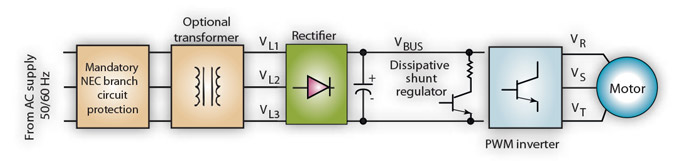
The basic structure of the servo system to be sized
is illustrated in Figure 1.
Many laborious calculations are made in the typical sizing
process. Calculations include reflected load inertias, RMS
and peak torques, average and peak currents, RMS maximum
speeds, and so on.
Mechanical transmissions, gearing, and torsional
resonances
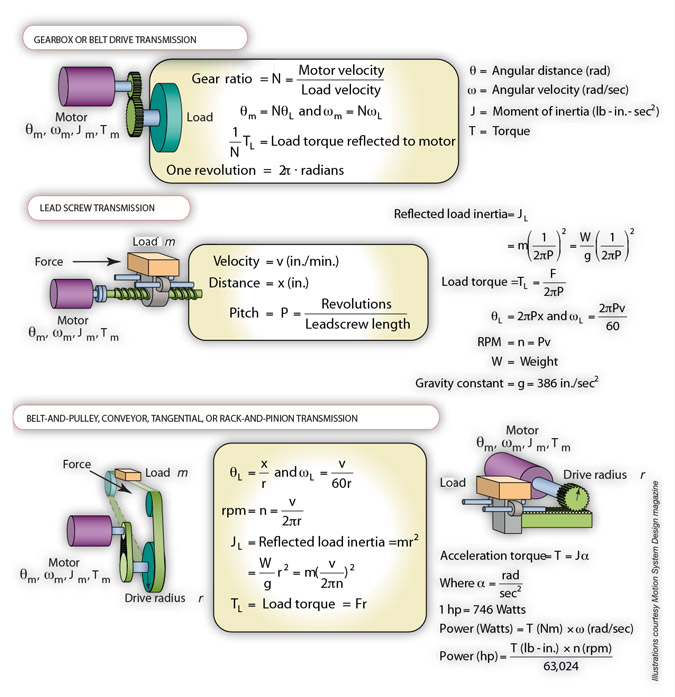
The most commonly encountered mechanical transmissions
can be analyzed for many applications and are shown
in Figure 2. The choice of mechanical transmission is determined
by application requirements. Useful equations
in Figure 2 characterize the various transmission types.
Another important decision is the choice of rotary gearing
(if any) between the motor shaft and the mechanical
transmission/load to be moved. There are many reasons
for considering gear reduction in a motion control application
such as:
Reducing inertial mismatch between motor and load.
Inertial mismatch should be minimized for high-performance
applications, and is 1:1 for best results. Gearing
reduces the reflected inertia by the square of the reduction
ratio. For example, a 10:1 gear ratio reduces reflected
load inertia by 10 squared or 100. However, do not fail to
include the extra inertia of couplings, pulleys, or gears, as
these can be significant and offset the inertia reduction.
The addition of couplings or thin drive shafts will increase
the compliance of the system as the motor winds up the
transmission like a spring, this will result in resonances
as the load moves and the spring is unwound. Also note
that adding a gearbox will add backlash to the system,
effectively removing the load from the motor within the
backlash angle. This can lead to motor high frequency
instability at standstill, causing excess motor heating and
failure to accurately track contoured moves.
- High torque and low-speed applications. Most conventional
brushless servomotors can operate at high
speeds, such as 3,000 to 6,000 rpm. The torque increase
due to the gear reduction (motor torque is multiplied by
the gear ratio) is used to keep the motor physical size as
small as possible. This is because the continuous torque
rating (and not horsepower) determines the motor size
and cost. Horsepower is equal to torque x speed. Therefore,
for minimum motor size and inertia, motor speed
should be as high as possible. - Limited space. If there are space constraints, the use
of gearing can allow a smaller overall package or it can
allow the motor to be repositioned in a different
localocation
or orientation. Many different factors need to be
taken into account when selecting gearing technology.
The first step for a high-performance servo application
is to determine which gearing technology best fits the
application – by answering the following questions:
- What are the physical limitations for the application?
For example, into what envelope must the motor/gearing
fit, and must the motor be positioned at a right
angle to the load? The three basic orientations are parallel,
in-line, and right angle gearing. - What reduction ratio is required? After deciding on
the basic classification, the next factor to consider is the
reduction ratio—illustrated in Figure 3 for the most
common gearing technologies. For example, timing
belts are generally not used for ratios above 3:1 while
harmonic type gearing is usually not available with ratios
below about 40:1.
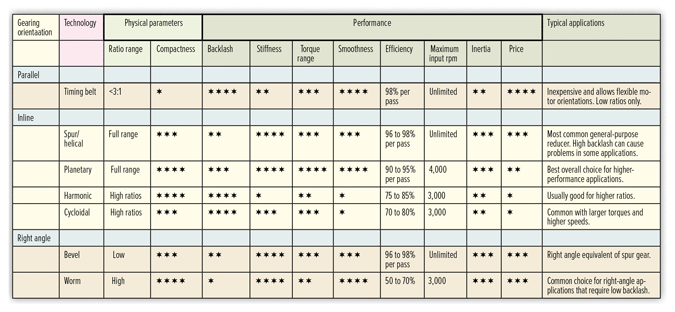
At this point in the selection process, the performance
parameters of the gearing technologies are examined to
further narrow the choice. Figure 23 includes the most
important performance parameters and their relative
ranking. These are only approximate rankings and variations
do exist.
For high-performance servo applications, three of the
performance parameters are of particular importance
and need additional explanation: accuracy, torquecarrying
capability, and reliability.
Accuracy is often equated to backlash but there is more
that must be considered. Backlash is the space between
mating parts or gears and it is usually specified in degrees
or arc minutes. Normally, gears need backlash to run reliably
because space is needed to accommodate lubrication,
manufacturing errors, and eccentricities in the gears and
other components. The tradeoff is to keep the backlash
as low as possible without sacrificing efficiency or other
performance features. Excessive backlash can cause positioning
error and instability so low-backlash gearing is
generally preferred with brushless servo drives.
Other components of accuracy include stiffness (compliance),
transmission error, and output smoothness. Stiffness
is the amount of deflection measured when a load is applied
to the reducer. Insufficient stiffness will result in positioning
errors or torsional resonance problems. Transmission
error is a measure of how accurately the motor input shaft
position is translated through the reducer. Gear ratios are
seldom exact and positional inaccuracies are also caused
by gear imperfections. The torque and speed output must
also be smooth and free from ripple if the input speed and
torque is smooth and ripple-free. Eccentric-type reducers
(such as harmonic or cycloidal gears) typically have output
ripple under some operating conditions; timing belts and
spur, bevel, planetary, or worm gearing are less susceptible
to this characteristic.
The torque-carrying capability varies among the different
types of reducers and is usually related to the frame
size within any one type of technology. The objective is
to ensure that the chosen reduction method has ample
torque-carrying capability for the application. Some applications
are light-duty and do not place heavy torque
demands on the reducer. The torque-carrying capability
of the reducer should have a 25 to 50% safety margin to
ensure a long life.
Finally, reliability is primarily a function of the reducer
component quality, efficiency, and the life expectancy for
reducer type. For example, timing belts usually wear out
faster than spur gears. Worm gears, due to their sliding
gear action, also usually wear out faster than spur gears.
Preloaded contact members, as found in harmonic and
cycloidal gearing, wear out faster than the other forms of
gearing. Timing belt gearing should only be of the HTD
type to ensure high stiffness while V belt, non-HTD type
timing belts, and chains should be avoided with high performance
servo drives.
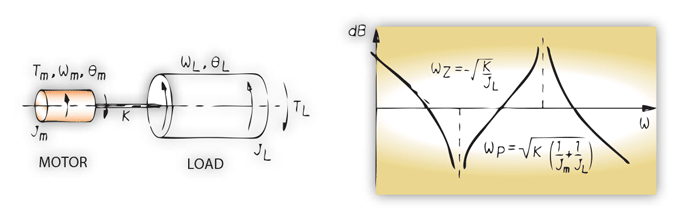
High performance servo drives typically are applied with
highvelocity loop bandwidths. In practice, a torsional resonance
exists due to mechanical compliance between
the load inertia and the motor inertia. A model of this
mechanical system and the open-loop frequency response
is shown in Figure 4. The compliance is modeled as a torsional
spring with its inertia and damping neglected. Best
results are obtained if the torsional resonant frequency
is kept as high as practical. Torsional stiffness K of a solid
round shaft is proportional to the fourth power of the diameter
and inversely proportional to the length. Therefore,
torsional stiffness is dramatically improved by selecting a
motor and other mechanical transmission element with
the largest shaft diameter.
A common torsional problem is improper coupling of the
motor to the load. A key-type coupling should be avoided
if possible; a compression-type coupling that is clamped
as close as possible to the motor flange is best. Axial shaft
loading due to impact shocks as a result of hammering the
coupling on the shaft is absolutely not allowed, as this can
damage the motor bearings or break the encoder disc.
Finally, if some torsional resonance is unavoidable and is
affecting the servo system performance, many suppliers
can provide electronic damping schemes in the servo drives
that help minimize the torsional resonance effect.
Motion Profile Considerations
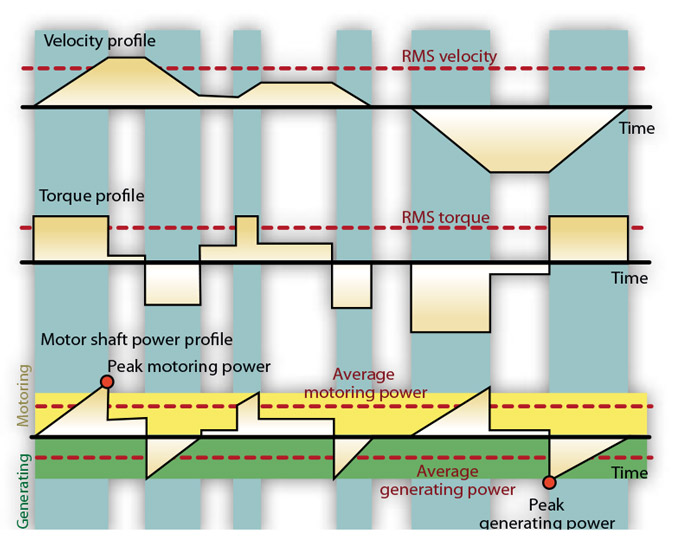
With the load defined, the worst-case velocity-time or
velocity-distance profile (as in Figure 5) is analyzed to determine
the following significant information:
- RMS and peak torque requirement of the motor
- RMS and maximum speed requirement of the motor
- Average and peak current requirement of the amplifier
- Average and peak motoring power
- Average and peak generating power
Arbitrary motion profiles can be defined and, along with
the mechanical system information, are used to calculate
the significant sizing information. Different mechanical
parameters (such as gearing), motion profiles, and motor
choices can be quickly and easily analyzed for the optimum
selection of a motor/amplifier combination.
Sinusoidal Brushless Motor Specifications
ElectroCraft specifies the important motor constants for a
three-phase sinusoidal back-EMF motor as:
Ke = line-to-line peak volts/KRPM
Kt = in-lb/peak phase amps
R = line-to-line resistance (Ohms)
L = line-to-line inductance (Henrys)
The peak value of the line-to-line voltage or phase amps
is defined as the zero to peak value of the sine wave. For
reference, the RMS value of a sine wave is the peak value
divided by the square root of two. Also, Kt is related to Ke:
Kt = Ke/11.834 for a DC motor
Kt = Ke/13.662 for a sinusoidal current with a sinusoidal-EMF
brushless motor.
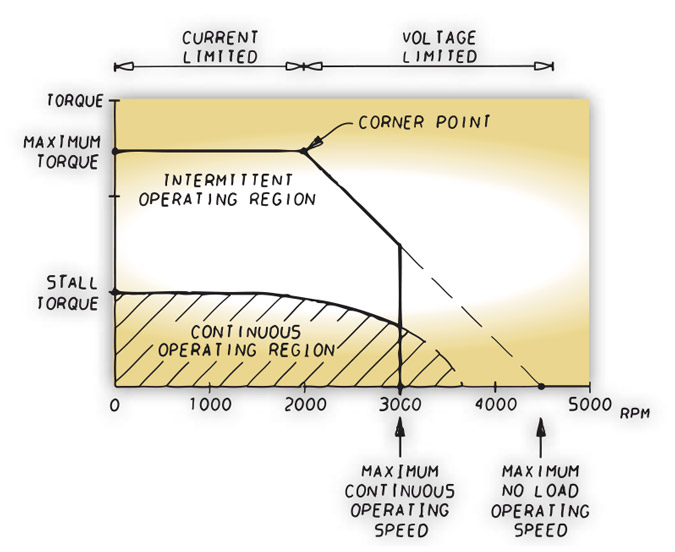
The torque-speed curve of a brushless servo system is
shown in Figure 6. The continuous operating region is
defined by operating the motor to the maximum allowable
winding temperature at various speeds and recording
the output torque. The continuous torque rating is worst
case if the motor is in free air during the test. Electro-
Craft brushless motors are normally rated mounted to an
aluminum plate of a specified dimension. Notice that the
continuous torque output of the motor decreases as the
speed is increased. Eventually the continuous torque is
reduced to zero, this occurs when the BEMF voltage and
winding inductance limit the current to a level where the
motor generated torque matches the motors internal drag
torque from bearing friction and windage. The low-speed
portion of the peak curve is usually limited by the amplifier
peak current rating; available amplifier voltage usually limits
the high-speed portion of the peak torque curve. As
the speed increases, a voltage limit is reached which causes
peak torque to roll off at higher speeds.
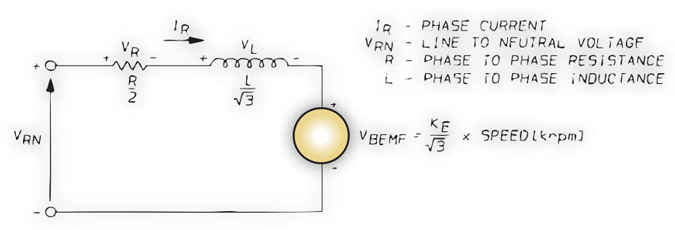
To better understand the torque-speed characteristics of
the sinusoidal brushless motor, refer to the steady state
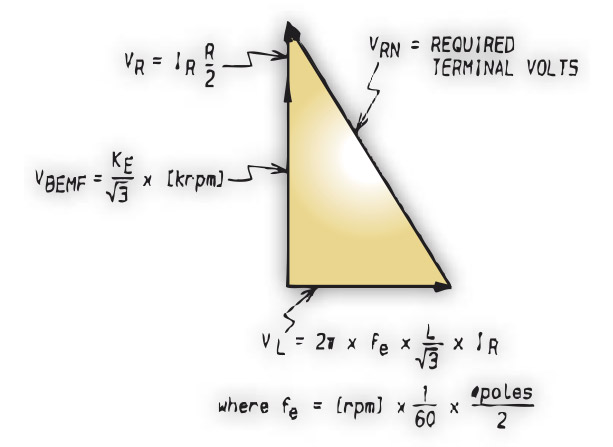
per phase model shown in Figure 7. The voltage and current
quantities are sinusoidal and are related as shown in
Figure 8.
Notice how the voltage drop across the inductance begins
to dominate as speed (or frequency) increases, which
eventually causes the peak torque to roll off as mentioned
before.
By knowing the maximum available line-to-neutral motor
terminal volts, the peak torque characteristic as a function
of speed can be calculated using the per phase motor model.
The maximum line-to-neutral volts can be calculated
using the following relationships. (Refer to Figure 8.)
Vbus [DC volts] =
2 x VVL1-L2 [volts RMS line-to-line]
Maximum VRN [peak volts] = Vbus/3
Once completing the work to calculate the motor and
amplifier requirements, the torque-speed curves are used
to select the proper ElectroCraft motor/amplifier combination.
The continous motor torque should be avaible at the RMS
velocity of the motion profile. Some allowance should be
made for motor Kt and Ke tolerance and for voltage drop
due to low line conditions and transformer load regulation.
Figure 5 shows the motoring and generating power for
this incremental motion profile. Only the motoring power
is supplied from the AC power line, as ElectroCraft servo
drives do not regenerate power to the AC power line.
Actual AC power requirements are higher than the average
motorshaft power due to power losses in the motor,
drive, and transformer. A multiplication safety factor of
about two is used to account for the losses and power
factor. Many suppliers provide load regulation curves for
their standard transformers; one such curve is shown in
Figure 9.
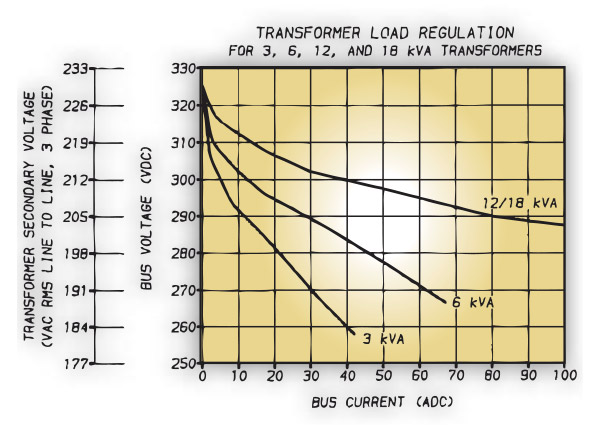
In servo applications, the peak power requirements for
good transformer voltage regulation usually require selection
of a power transformer that is oversized for continuous
power requirements. Conservatively sized motor/
amplifier operates longer without failure and reduces
application problems that are caused by under sizing the
motor/amplifier combination.
Up to now, it has been assumed that the motion profile
cycle time is short compared to the motor thermal time
constant. The motor thermal time constant is defined as
the time to reach 63.2% of the rated temperature rise
when rated current is supplied to the motor. The motor
thermally averages the power losses and reaches a constant
steady state temperature. Some applications apply power
and remove power to the motor with cycle times that are
similar to the motor thermal time constant. In these cases,
the motor temperature will fluctuate up and down as the
power is applied and removed. To properly size these
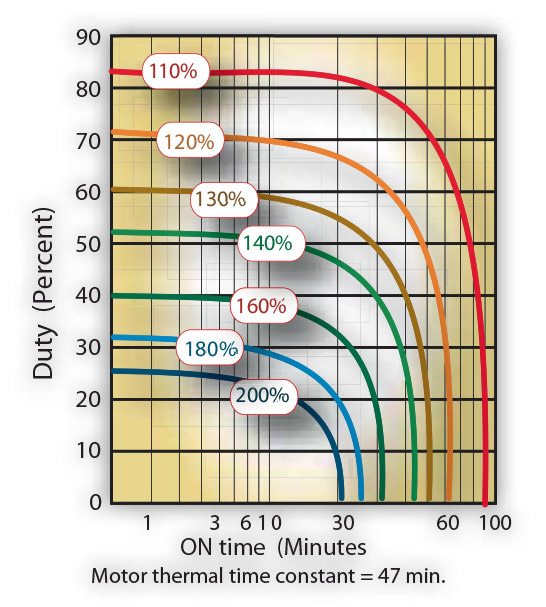
applications, duty cycle curves can be provided
for the motors as shown in Figure 10. For example,
the operating point labeled A in Figure 10 allows
the motor to repetitively
produce 200% continuous torque for about 6 minutes
and no torque for about 24 minutes. The amplifier has a
very short thermal time constant compared to the motor so
the amplifier must be oversized to handle the peak motor
torque on a continuous basis in these types of overload
applications.
Brushless amplifier dissipative shunt
The final consideration in sizing the amplifier concerns the
dissipative shunt regulator shown in Figure 1. Braking the
motor returns energy stored in the rotating mechanical
mass to the amplifier power supply. Because the power
supply is not able to regenerate this energy back to the
AC input supply, the power supply capacitor is charged up
beyond its normal level. If the excess braking energy is low,
then the capacitor may be able to absorb the excess energy
and simply return it to the motor during the next motoring
period. However, if the excess energy is high, then a clamp
circuit is used to limit the bus voltage to a safe level and
to dissipate the excess energy as heat in a power resistor.
The shunt regulator is specified to handle a peak power
and a continuous power. If the peak power is exceeded,
then the clamp circuit will be unable to limit the voltage
to a safe level and the amplifier turns off. In practice, if
peak shunt power is being exceeded, check to see if the
current limit can be lowered or if the deceleration time can
be lengthened. Applications that frequently stop and start
with high inertia and high speed should be studied closely
to see if continuous shunt power is exceeded. Vertical applications
with a gravity load (especially ones without any
form of counterbalance) must be very carefully considered
as to continuous shunt power.
ElectroCraft drives have the ability to add external shunt
resistors that extend the continuous and peak shunt power
of the system. Figure 5 shows the generating power for
an incremental motion profile: Actual dissipated power
is less than the regenerated motor shaft power due to
motor losses, amplifier losses, and energy absorbed by
the bus capacitor.
Electrical Noise Considerations
Perhaps no other subject discussed so far in this handbook
is as misunderstood as electrical noise. Nothing strikes fear
in the industrial equipment user more than being told by
the drive vendor, “You have a noise problem.” While the
subject is complex and the theory can (and does) easily
fill a book, this section provides some guidelines that can
minimize noise problems.
The majority of installations exhibit no noise problems.
However, filtering and shielding guidelines are countermeasures
if problems arise. In contrast, grounding and
bonding guidelines combined with good panel layout
are simply good practices and should be followed in all
installations.
There are two characteristics to electrical noise: the generation
or emission of electromagnetic interference (EMI),
and the response, or immunity to EMI. The degree to which
a device emits no EMI, and is immune to EMI, is called the
device’s electromagnetic compatibility.
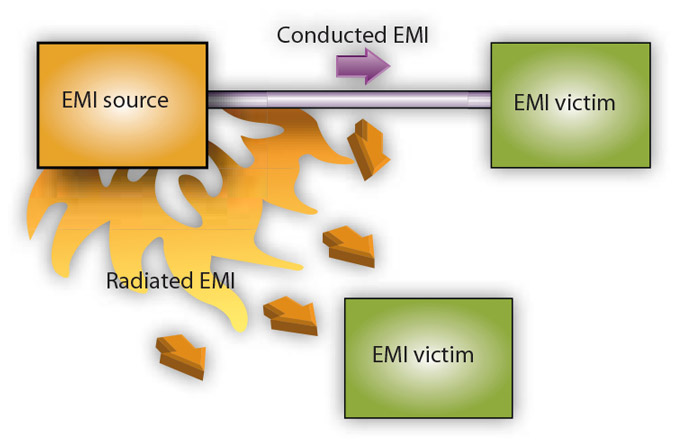
Figure 11 shows the commonly used EMI model. The model
consists of an EMI source, a coupling mechanism, and
an EMI victim. Devices such as servo drives and computers
(which contain switching power supplies and microprocessors)
are EMI sources. The mechanisms for the coupling of
energy between the source and vicitm are conduction and
radiation. Victim equipment can be and electormagnetic
device that is adversely affected by the EMI coupled to it.
Equipment immunity is primarily determined by its design,
but how one wires and grounds the device is also critical
for EMI immunity. Therefore, selecting equipment designed
and tested for industrial environments is paramount.
Selecting equipment that is certified or designed to meet
industrial immunity standards is a good start. Laying out
the electrical panel in “Clean” and “Dirty” zones to segregate
motor power wires from sensitive analog inputs
etc. will cost very little in planning time compared to the
cost of sending an engineer to site to find an intermittent
EMI event.
Another tip: In industrial environments, use encoders with
differential line driver outputs rather than single-ended
outputs, and use digital inputs/outputs with electrical isolation,
such as those provided with optocouplers.
Reconsider Figure 11. This EMI model provides only three
options to eliminate the emission problem. The EMI source
could be reduced, which in the case of servo drives would
require slowing power semiconductor switching speeds.
However, this degrades drive performance with respect to
heat dissipation and speed/torque regulation.
Another possibility is to harden the victim equipment,
which may not be possible or practical. The final and most
realistic solution is to reduce the coupling mechanism between
the source and victim – with filtering, shielding, and
grounding.
Filtering
As mentioned, high-frequency energy can be coupled between
circuits via radiation or conduction. The AC power
wiring is one of the most important paths for both types
of coupling mechanisms. The AC line can conduct noise
into the drive from other devices, or can emit conducted
noise directly into other devices. It can also act as an antenna
and transmit or receive noise between the drive and
other devices.
One method of improving the EMC characteristics of a
drive is to use an isolation AC power transformer to feed
the amplifier its input power. This minimizes inrush currents
on power-up, and provides electrical isolation. In addition,
it provides common mode filtering, though the effect is
limited in frequency by the inter-winding capacitance.
Note: “Common mode” noise is present on all conductors
referenced to ground while “differential mode” noise is
present on one conductor referenced to another conductor.
An alternative is to use AC line filters to reduce the conducted
EMI emitting from the drive. This allows nearby
equipment to operate undisturbed. In most cases, an AC
line filter is not required unless other sensitive circuits are
powered off the same AC branch circuit. The basic operating
principle is to minimize the high frequency power
transfer through the filter.
An effective filter achieves this by using capacitors and
inductors to mismatch the source impedance (AC line) and
the load impedance (drive) at high frequencies
The machine builder is responsible for the suitability of the
filter selection in a specific application.
Selection of the proper filter is only the first step in reducing
conducted emissions. Correct filter installation is crucial
to achieving both EMI attenuation and to ensure safety.
All of the following guidelines should be met for effective
filter use.
- The filter should be mounted to a grounded conductive
surface to establish a high frequency (HF) connection
to that surface. To achieve the HF ground, the surface
interface between the filter and structure must be free
of paint or any other insulator. This may require paint
removal from the inside of a cabinet. A wire should not
be used to ground the filter because it will act as an
antenna when ground currents are present. - The filter must be mounted close to the drive input terminals.
If the distance exceeds 1 ft, then a strap should
be used to connect the drive and filter, rather than a
wire. - The wires connecting the AC source to the filter should
be shielded from, or at least separated from, the wires
(or strap) connecting the drive to the filter. If the connections
are not segregated from each other, then the
EMI on the drive side of the filter can couple over to the
source side of the filter, thereby reducing, or eliminating
the filter effectiveness. The coupling mechanism can
be radiation, or stray capacitance between the wires.
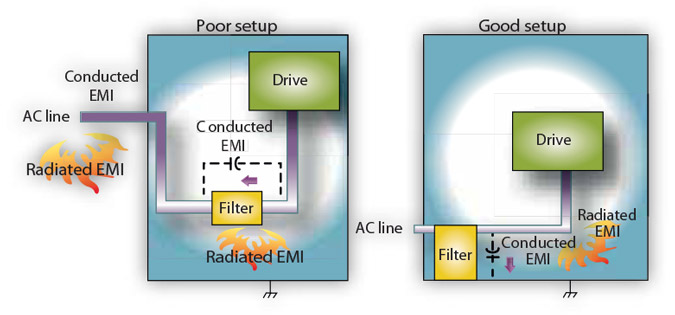
The best method of achieving this is to mount the filter
where the AC power enters the enclosure. Figure 12
shows a good installation and a poor installation.
When multiple power cables enter an enclosure, an unfiltered
line can contaminate a filtered line external to the
enclosure. Therefore all lines must be filtered to be effective.
The situation is similar to a leaky boat. All the holes
must be plugged in order to prevent sinking.
WARNING: The filter must be grounded for safety before
applying power due to the leakage currents. Failure
to properly ground the filter can be hazardous.
The only reasonable filtering at the drive output terminals is
the use of inductance. (Capacitors would slow the output
switching, and deteriorate the drive performance.) A common
mode choke can be used to reduce the HF voltage
at the drive output to reduce emission coupling through
the drive back to the AC line. However, the motor cable
stills carries a large HF voltage and current. In fact, motor
cable length directly affects the amplitude and frequency
of emissions on the AC line. Therefore, it is very important
to segregate the motor cable from the AC power cable, or
to use a shielded motor cable. For applications where long
motor cables are required, the need for AC line filtering
increases. More information in cable shielding and segregation
is contained in the section on shielding.
Grounding, Shielding and Segregation
Grounding
High-frequency (HF) grounding is different from safety
grounding. A long wire is sufficient for a safety ground,
but is completely ineffective as a HF ground due to the wire
inductance. As a rule of thumb, a wire has an inductance of
20 nH/in., regardless of diameter. At low frequencies it acts
as constant impedance; at intermediate frequencies as an
inductor; and at high frequencies as an antenna. The use
of ground straps is a better alternative to wires. However,
the length to width ratio must be 5:1 or better yet 3:1 to
remain a good high frequency connection.
The ground system’s primary purpose is to function as a
return current path. It is commonly thought of as an equipotential
circuit reference point, but different locations in
a ground system may be at different potentials. This is due
to the return current flowing through the ground systems
finite impedance. In a sense, ground systems are the sewer
systems of electronics and as such are sometimes neglected.
The primary objective of a high frequency ground
system is to provide a well definded path for HF currents,
and mininimize the loop area of the HF currents paths. It
is also important to separate HF grounds from sensitive
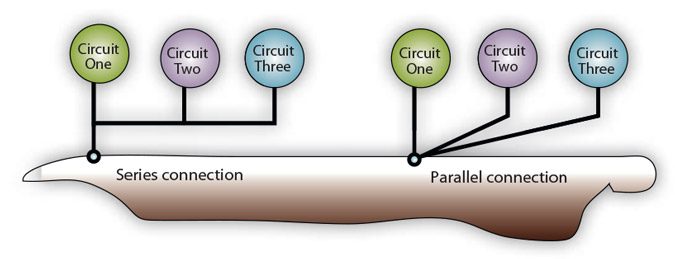
circuits’ grounds. A single-point parallel-connected ground
system is recommended. Figure 13 shows single-point
grounds for both series (daisy chain) and parallel (separate)
connections.
A ground bus bar or plane should be used as the “single
point” at which circuits are grounded. This minimizes
common (ground) impedance noise coupling. This ground
bus bar (GBB) should be connected to the AC ground, and
if necessary, to the enclosure. All circuits or subsystems
should be connected to the GBB by separate connections.
These connections should be as short as possible,
and straps should be used if possible. The motor ground
conductor must return to the ground terminal on the drive,
not to the GBB.
Shielding and segregation
The primary propagation route for EMI emissions from a
drive is through cabling. The EMI radiating from the drive
enclosure itself drops off very quickly with distance. The
cables conduct the EMI to other devices, and can also reradiate
the EMI. Therefore, cable segregation and shielding
can be important to reducing emissions. Cable shielding
can also increase the level of immunity of a drive.
The following suggestions are recommended for all installations,
because they are inexpensive to implement.
Signal cables (encoder, serial, analog) should be routed
away from the motor cable and power wiring. Separate
steel conduit can be used to provide shielding between the
signal and power wiring. Do not route signal and power
wiring through common junctions or raceways.
Signal cables from other circuits should not pass within
1 ft of the drive.
The length of parallel runs between other circuit cables and
the motor or power cable should be minimized. A rule of
thumb is 1 ft of separation for each 30 ft of parallel run.
The 1-ft separation can be reduced if the parallel run is less
than 3 ft. Cable intersections should always occur at right
angles to minimize magnetic coupling.
Do not route any cables connected to the drive directly
over drive vent openings. Otherwise, the cables will pick
up the higher levels of emissions that leaked through the
vent slots. If you are constructing your own motor cable,
a four-conductor cable should be used, with the four conductors
twisted. The ground conductor must be attached
to the motor and drive earth terminals.
The encoder mounted on the brushless servomotor should
be connected to the amplifier with a cable using multiple
twisted wire pairs and an overall cable shield. Otherwise
noise on the encoder signals can cause drive faults in the
drive.
If EMI problems persist, additional counter measures can
be attempted. Here are several suggestions for system
modifications.
Placing a ferrite “donut” around a signal cable may help.
The ferrite attenuates common mode noise but does
nothing for differential mode noise. Connecting cable
shields directly to the drive chassis instead of the cable
connectors can reduce the effect of external EMI on the
drive operation.

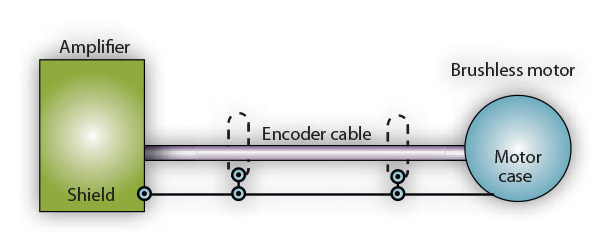
Use a shielded motor cable terminated at the circular section
at both ends. The shield should be connected to the
drive earth terminal, or chassis at the drive end, and the
motor frame at the motor end. The coaxial configuration
provides magnetic shielding, and the shield provides a return
path for HF currents, which are capacitively coupled
from the motor windings to the frame. If power frequency
circulating currents are an issue, a 250-VAX capacitor
should be used at one of the connections to block the
50/60 Hz currents, but pass the HF currents. Figure 15
illustrates all the motor cable options discussed in this
section. Suppress each switched inductive device that
is near the servo amplifier. This includes solenoids, relay
coils, starter coils and AC motors (such as moto driven
mechanical timers). DC coils should be suppressed with
a “freewheeling” diode connected across the coil in the
non-conducting direction. AC coils should be suppressed
with RC filters: A 220 ohm 1/2 watt resistor in series with
a 1/2 microfarad, 600 volt capacitor is commonly used.
Note: This handbook section presents some
guidelines that can minimize noise problems.
However, equipment EMC performance must meet
regulatory requirements in various parts of the
world, specifically in the European Union. It is the
responsibility of the machine builder to ensure that
a machine meets the appropriate requirements as
installed.
Company Information
ElectroCraft, Inc. is a global provider of fractional-horsepower
motors and motion control solutions for both industrial
and commercial applications. Capitalizing on many
years of experience has resulted in a broad family of motor
and motion control components available. ElectroCraft
products include:
Sinusoidal brushless servomotors utilizing either the
high energy product neodymium iron boron permanent
magnets for the lowest rotor inertias or the cost-effective
ferrite permanent magnets for medium rotor inertias.
Digital sinusoidal brushless servo amplifiers designed
to provide today’s OEM with maximum brushless servo
performance at the lowest possible cost. The ACE500 Series
utilizes the latest in DSP-based drive design architecture
to provide software selectable torque, velocity and
position mode (optional) operation. Sine wave commutation
using encoder feedback provides smooth torque at low
speeds for demanding motion control requirements found
in robotic, direct drive, and linear motor applications.
Cost effective analog and two-quadrant brushless
DC speed controls. These drives include ramp generator
and braking functions for controlled acceleration and deceleration.
Mode of operation is set by simple DIP switches.
All of the above components can be combined from a
single manufacturer to produce high performance motion
control systems for a variety of automation tasks. Typical
applications include machine tools, EDM machines, coil
winding equipment, medical equipment, press feeders,
thermoforming machines, robotics, automotive assembly
and machining equipment, postal sorting machines,
material handling equipment, packaging equipment, and
other types of specialty machines requiring precise control
of torque, velocity and position.
ElectroCraft is headquartered in Dover, New Hampshire
with operations in the United States, Europe, and Asia.