
Gearing Options for Small-Frame Brushless DC Motors
November 28, 2017
The Difference Between a Traditional BLDC/Gearbox Combination and the ElectroCraft LRPX with Integrated Planetary Gearbox
BRUSHLESS DIRECT-CURRENT
(BLDC) MOTORS are the go-to
motor type for designers looking
to move large objects quickly and
accurately. Their small frame size
combined with high torque and
dynamic responsiveness makes
BLDCs essential to laboratory
equipment, medical devices, precision
measurement tools, and more.
In these and other applications,
the torque available at a given motor
frame size is a designer’s limiting
factor. Designers can add a gearbox,
but the torque gained comes at a cost
to footprint compactness, precision,
efficiency, and responsiveness.
Recently introduced designs, like
those in ElectroCraft’s LRPX series,
combine specially-designed BLDCs with
gearboxes for a streamlined gearmotor
design. The integrated design minimizes
the number of components for a smaller
footprint, greater accuracy, and better
dynamic response.
Read on to learn more about the
difference between traditional BLDC
motor options and integrated BLDC
gearmotors.
Motor Design
All BLDC motors have the same basic
components: a stator, a rotor, a sensing
device, and a means of coupling to a
gearbox or object being driven. Standard
BLDCs use slot-less stators suited to
high-speed operation. In integrated
gearmotors, encapsulated closed slot
stators support higher torque-power
ratios and improve heat transfer.
Both standard and integrated gearmotor
BLDCs use permanent magnet rotors to create
rotary motion. Standard BLDCs feature two
or, more commonly, four magnetic poles.
Integrated gearmotor designs use eight
poles for greater responsiveness and torque
at lower speeds.
Once the electromagnetic interaction
between the rotor and the stator has started
motion, that motion needs to be put to work.
For many applications, designers turn to
gearboxes to adjust the motor torque and
speed to match the torque and speed demands
of the application.
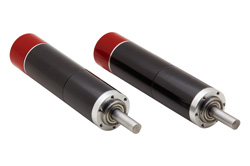
LRPX series are designed with an integrated planetary gearbox
to save space over the standard BLDC-plus-gearbox configuration
while delivering superior torque and efficiency.
Standard BLDC motors require an additional
gearbox, along with a coupling to connect the
motor shaft to the gearbox, increasing its
footprint and sometimes causing compatibility
issues. On the other hand, integrated gearmotors
contain a planetary gearbox directly coupled
to the motor itself. This integration minimizes
the flexing of components, ensures efficient
operation, and eliminates compatibility problems.
Motor Performance
Designers make choices about motor design
with the primary aim of getting the performance
they need out of their system. The performance
characteristics designers most often consider
are motor speed, torque, and power.
BLDC motors are known for their ability to
operate at high speeds. Standard BLDCs without
added gearboxes can run at speeds as high as
30,000 rpm. However, almost all gearboxes are
limited to a top speed of 10,000 rpm or less.
Thus, standard BLDCs attached to gearboxes are
rated for operating speeds that are much higher
than the gearbox maximum input speed. In contrast,
the BLDC motor
in an integrated gearmotor may
have top speeds up to 9,000 rpm, but they are
generally rated for 6,000 rpm operating
speeds—ideal for a gearmotor application.
Torque, usually measured in
ounce-inches or millinewtonmeters
for BLDC motors, is
another important consideration.
Many standard BLDC motors have
published torque output levels that
are only available at speeds above
20,000 rpm and not useable when
attached to a gearbox. Useable
torque may be significantly
reduced at gearbox rated speeds.
Integrated gearmotors are
designed to combine the peak
capabilities of both the BLDC
motor and the planetary gearing.
Integrated planetary gearing can
then produce peak torques over
400 oz-in. The high torque density
of an integrated gearmotor also
enables lower gear ratios in the
planetary gearing.
Motor Efficiency
BLDC motors are also known
for their efficient conversion of
electricity into motion. Maximum
operating efficiency occurs near
the motor’s peak speed. As
noted above, the speed of peak
efficiency of a standard BLDC
motor coupled with a gearbox, 28,000 rpm, is outside
the setup’s operating envelope. Standard BLDC motors
operating at speeds within the speed range of the gearbox
are operating well below their peak efficiency.
On the other hand, integrated gearmotor BLDCs are
designed so that the speed of maximum motor efficiency
is within the operating speed envelope of the planetary
gearing, maximizing overall efficiency.
Gearbox designers seek to minimize gear ratios in order
to deliver power most efficiently and use the least energy.
For systems like standard BLDCs which have torque
under 4 oz-in at gearbox speeds, attached gearboxes
need to have much higher gear ratios. This causes energy
efficiency, power delivery, and dynamic responsiveness to
suffer.
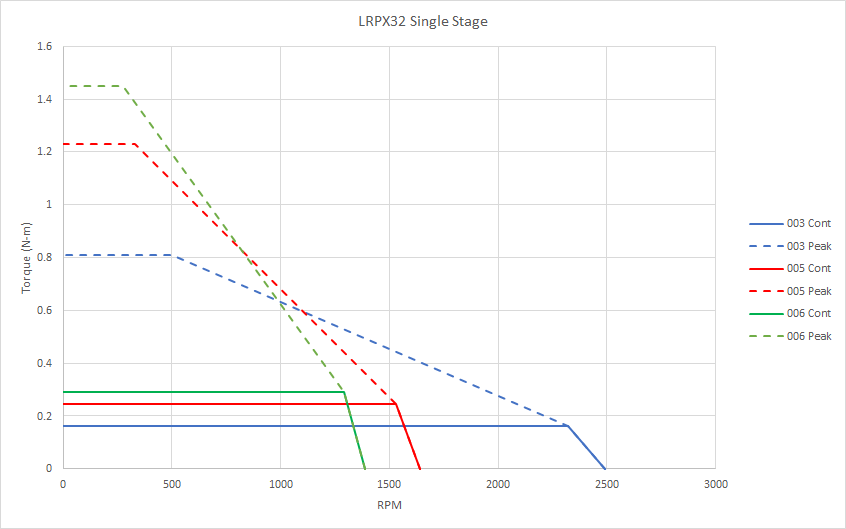

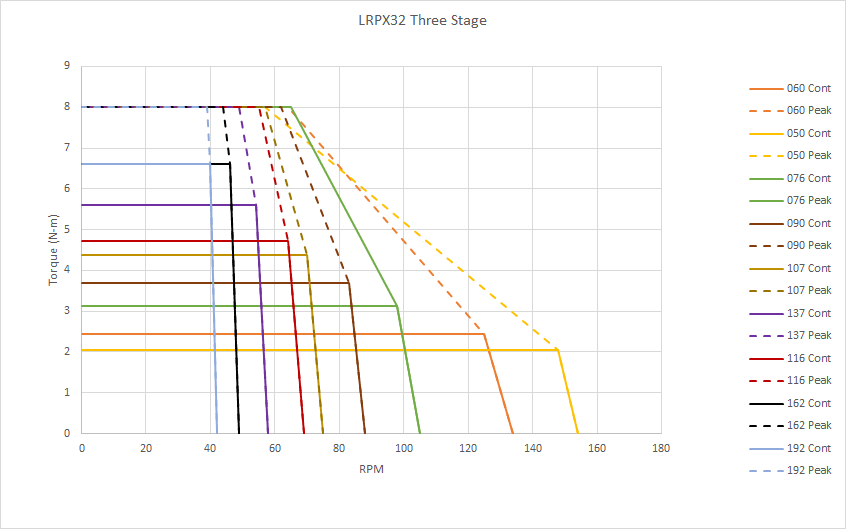
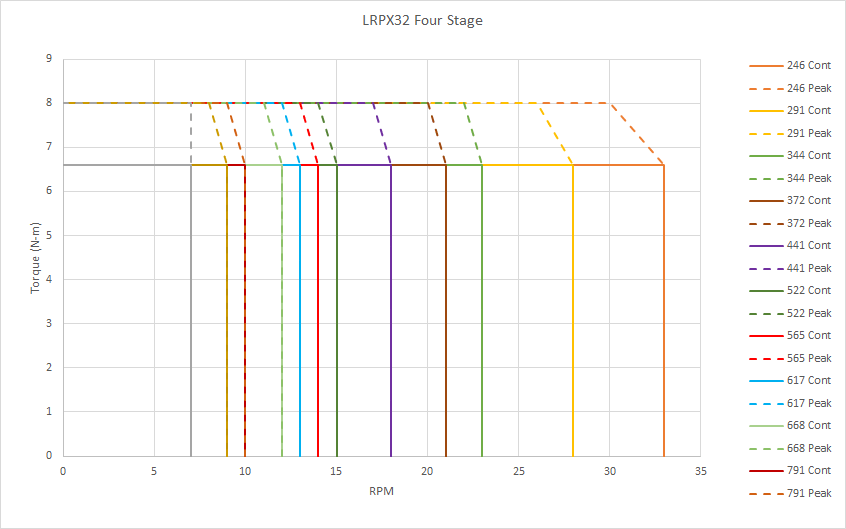
BLDC motor with up to four stages of planetary gearing. The combination can supply a variety of speeds and
torques as high as 6.6 N-m in continuous operation.
One comparison comes from motors used in peristaltic
pumps, such as those in pharmaceutical operations. A
large pump delivering 2 Nm of torque would require a
BLDC motor attached to a gearbox with a 51:1 ratio. When
engineers replaced the standard motor with an
ElectroCraft LRPX-32
integrated gearmotor, they were able to use a
33:1 gear ratio and realize a 25% efficiency improvement.
Design Considerations
In the peristaltic pump example above, energy efficiency
is not the only benefit. The LRPX-32 also inhabited a 27%
smaller footprint than that of a standard BLDC paired with
an added gearbox. As designs for devices of all kinds
continue to shrink, size efficiency is becoming just as
important as energy usage.
Because integrated gearmotors are designed to contain
both the motor and planetary gearing, they use space
more efficiently. No additional couplings are required to join
the motor to a gearbox as in a standard BLDC motor. The
integrated design can even accommodate linear motion
without the need for a ballscrew or similar device.
Designers of an automated guided vehicle (AGV)
saved 54% of the volume of their steering motor by switching
to an ElectroCraft LRPX-32. The 1.4 Nm steering setup
converted from a 79:1 gear ratio to a 33:1 ratio and cut
energy use by a quarter.
Noise is another design consideration in many
applications. Noise often comes from the misalignment
of system components, a common concern for standard
BLDCs coupled to aftermarket gearboxes. Because
integrated gearmotors are designed as a unit and aligned
at manufacture, they tend to run more quietly.
A final consideration designers often encounter is the
motor’s ability to resist high humidity, water droplets, dust,
debris, and large ranges of temperatures in its operating
environment. All BLDC motors use either Hall effect
sensors or encoders, so they need greater protection from
the elements as compared to mechanically commutated
brushed dc motors.
Standard BLDC motors are not encapsulated. Thus, they
are able to offer IP40 protection that excludes slim objects
like wires and small screws from sensitive electronics but
provides no protection against moisture or water.
Integrated gearmotors, on the other hand, have the
option of sealed bearings for up to IP65 level protection
that excludes all dust and water jets. Integrated gearmotors
are also rated for operating temperatures between −42 and
155˚C.
Making a Difference with Motors
BLDC motors are a staple for motion needs across
a variety of industries. Their energy efficiency, torque
capabilities, and speeds make them attractive to designers.
However, for standard BLDC motors, these three attributes
have not been simultaneously accessible; the gearing
needed to attain useful levels of torque precludes the motor
reaching peak speed and efficiency.
Integrated gearmotors like those in ElectroCraft’s LRPX
line combine efficient BLDC motors with an integrated
planetary gearbox. This design permits high torque and
high power operations while preserving useable speed and
energy efficiency. These performance benefits, combined
with lower noise and the ability to operate in a variety
of environments, make integrated BLDC gearmotors
an attractive option for designers who require precise
responsive motion in an efficient package.