
A Technical Guide to Custom Versus Standard Servo Drives
January 12, 2025

For most motion control applications, a standard servo drive isn’t just adequate — it’s the best
solution. These off-the-shelf units offer a practical balance of proven performance, immediate
availability and straightforward integration, making them the go-to choice for many industrial,
commercial and consumer equipment.
However, certain applications may extend beyond what standard servo drives can deliver. For
example, space constraints may call for varying form factors. Harsh environments may demand
protection levels that exceed standard ratings. Precision motion requirements may necessitate
algorithms tuned specifically to the motor-load combination. In these and other scenarios, a standard
unit simply won’t cut it, making custom drives the optimal solution.
In this white paper, we’ll identify some scenarios and use cases where customization delivers
meaningful value — helping you determine when standard drives suffice and when custom solutions
justify the investment.
Navigating Physical and Environmental Challenges
The drive’s physical operating environment is one factor
that can help you determine whether a standard unit will
work or if you’ll need to go custom. Customization often
becomes necessary when the operating space is severely
limited or when conditions are particularly demanding.
Standard servo drives typically come in panel-mounted or
PCB-mounted formats, which work well for conventional
installations. However, bear in mind that specialized
equipment often has limited real estate for electronics,
making standard shapes or sizes impractical. For high-volume
OEM customers who don’t need all the connectors
and full functionality of a standard enclosed product,
ElectroCraft can supply board-only versions extracted
from standard products. These boards can be paired with
custom heat sinks to achieve the same performance as
standard off-the-shelf solutions but in a smaller package
— a common customization option for cost-sensitive,
space-constrained applications.
Applications requiring an integrated or embedded approach
— where the drive must be integrated directly with the motor
(called a motor-mounted drive) — represent another scenario
of when you may need a custom unit.
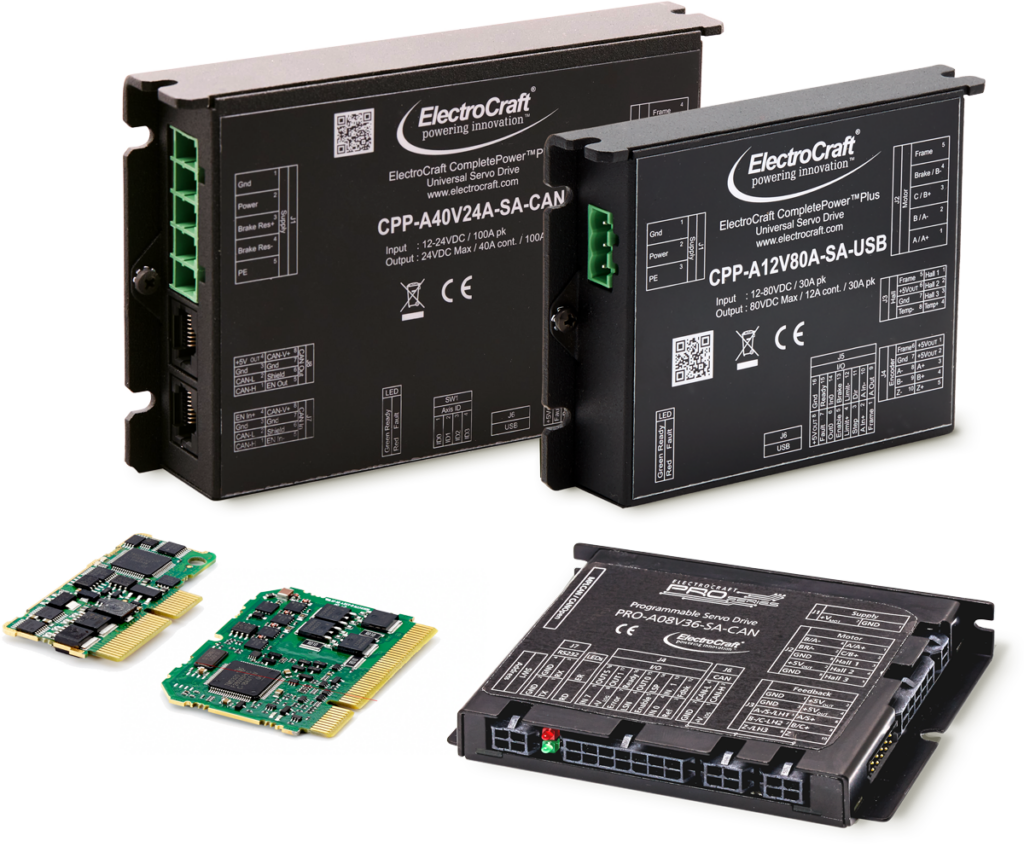
with built-in motion control, ElectroCraft has the right solution
to fit your application.
Additional examples include systems that can’t
accommodate a typical rectangular enclosure. In these
cases, you may need non-standard shapes like round
drives that mount directly onto motor backs. And in terms
of packaging, drives can be customized into ultra-compact
PCB assemblies or with adapted standalone chassis
mounts to fit specific enclosure or mounting schemes.
Environmental conditions add another layer of complexity
in the choice to go custom. Standard commercial and
industrial drives aren’t designed for harsh or extreme
operating conditions, such as:
- Applications with extreme heat or cold — e.g.,
ambient temperatures exceeding 100°C or operating
outside standard industrial temperature ranges. - Military and defense systems, which often require
drives that meet MIL-SPEC requirements for shock,
vibration and temperature extremes. - Deep-sea and marine applications, which require
structural modifications to withstand high pressures
at depths reaching several thousands of meters.
Protection against contaminants is another reason for
customization. Drive options range from simple protective
covers and conformal coating for circuit boards, to full
encasement in potting compound for complete
contamination prevention. These design modifications
matter in industries like food and beverage processing,
industrial machinery and agricultural automation.
In one example, ElectroCraft developed an IP69K-rated
drive and motor package for an agricultural application
where up to fifty drives and motors mounted on a tractor
implement automatically control dispensing for each
row in the field. This custom solution involved taking the
standard drive board and motor, creating a new sealed
enclosure and adding waterproof cables and connectors.
The IP69K rating ensures the drives can withstand high pressure
washdown, in addition to custom hardware that
can withstand the extreme vibration and temperature
ranges often encountered on farms.
Another example involves a custom drive integrated
into a joystick with force feedback (haptic) capabilities
for a steering system. The drive had to meet MIL-SPEC
requirements for shock, vibration, temperature and
ingress protection, which required a conformally-coated
drive board in a sealed package.
Matching Power Delivery to Motor and Duty Cycle Requirements
The motor’s duty cycle and size may require power
delivery specifications that fall outside the range of a
standard servo drive. Because standard servo drives offer
fixed ranges of operating voltages and output currents,
precisely matching the power source to a specific motor
often requires a custom unit. If an application needs
current or voltage levels beyond standard specifications —
for example, an output between the continuous currents
of standard models or a specific voltage for efficient
operation — custom drive solutions may be necessary.
ElectroCraft can customize drives for any voltage
or any wattage within the platform’s capabilities
and any reasonable current level. Standard
offerings are scaled at 6A, 12A, 24A, 40A and
50A continuous, with the largest drive capable
of 100A peaks, but end-users requiring specific
current ratings between these values can request
custom configurations.
One recent customization request came from a large OEM
in laboratory diagnostics. The company needed a drive
to control a NEMA 34-frame BLDC motor in a low-current
application — only 3 to 4A. In addition, the specification
also called for a universal AC line input capability; the drive
needed to accept 85 to 265V AC anywhere in the world
and convert it to DC to run the motor without any jumper
settings or physical adjustments.
The customized solution included an integrated power
factor controller that reduced harmonics on the AC line
while allowing operation at universal voltages — similar to
a laptop power supply. This system eliminated the need
to size electronics according to the highest voltage (220V)
when using 120V, which traditionally meant paying for
the higher voltage capability. The power factor controller
draws current in phase with the line voltage, producing
constant DC power to run the motor at the appropriate
stepped-down voltage.
Other important factors are duty cycle and torque
requirements. High-acceleration applications —
sometimes called pulse-duty operations — demand
substantial peak current to generate the peak torque
needed for rapid starts and stops. ElectroCraft’s drives
typically allow peak current values that are double the
continuous rating for a couple of seconds, which is
useful for quickly accelerating heavy loads. The drives
automatically limit current and reduce performance until
operation returns to the continuous range, preventing
thermal damage. If the required peak current and
continuous current exceed what a standard drive can
handle, a custom solution becomes essential to prevent
overheating and failure.
Managing Regenerative Braking
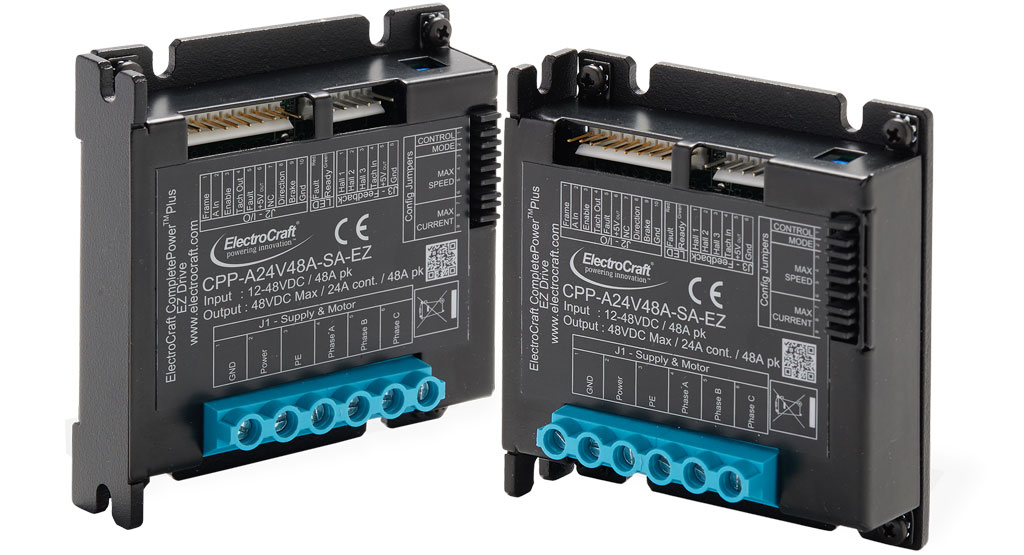
Applications requiring regenerative braking represent
another scenario where standard drives might not suffice.
When motors decelerate under load — common in
robotics and electronics manufacturing — they generate
energy that flows back into the drive. Many standard drives handle this with an onboard shunt regulator that
dissipates the excess energy as heat to keep DC bus
voltage safe.
Standard drives have fixed limits for how much
regenerative power their internal shunt can handle.
Applications with high-inertia loads or vertical axes, like
elevators or gantries where gravity assists downward
motion, can generate more power than a standard shunt
can dissipate. When the regenerative continuous or peak
power exceeds these built-in limits, a custom drive with
enhanced capabilities or a standard drive with an external
shunt resistor module becomes necessary to safely
handle the additional energy and prevent drive damage.
Tailoring Control Algorithms for Specialized Motion Profiles
Standard drives come with pre-configured algorithms
that work well for typical applications. For example,
standard ElectroCraft drives include Advanced Field
Oriented Control (FOC) for brushless and closed-loop
stepper motors, delivering good dynamic response
and acceptable torque ripple for most use cases. The
Universal Drive can run brushed DC, BLDC and stepper
motors with the unique ability to control steppers as
if they were brushless motors using FOC. This feature
provides both cost and mechanical advantages; BLDC
motors tend to have longer, skinnier form factors while
steppers are shorter and wider, giving designers greater
mechanical flexibility when space constraints vary.
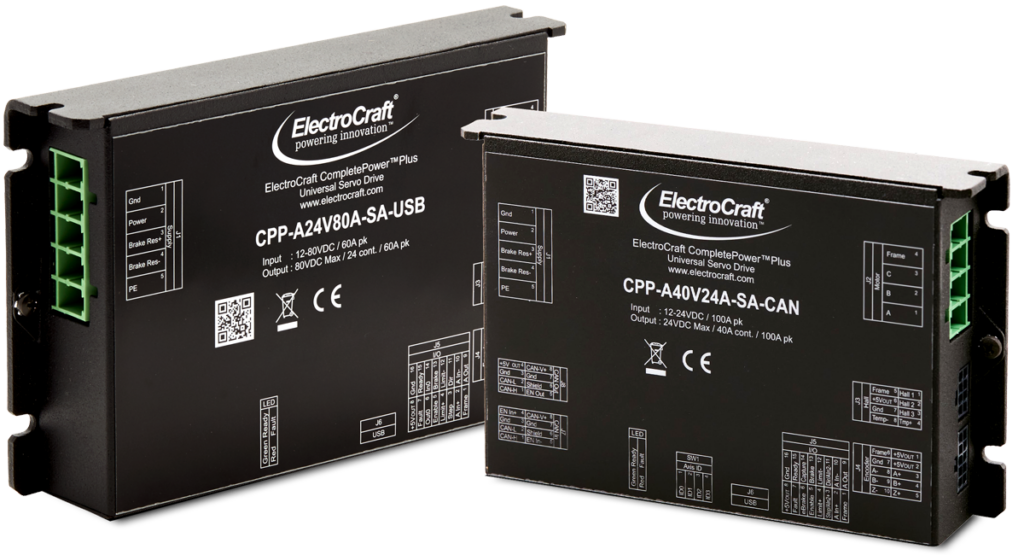
Additionally, built-in motor databases and preconfigured
settings allow you to complete most configurations in
seconds, with auto-tuning handling basic optimization.
For applications requiring standard velocity control,
torque control or basic positioning, these algorithms are
more than sufficient.
Customization often becomes necessary when the
motor-load combination has characteristics that standard
tuning can’t accommodate, necessitating custom control
algorithms and feedback processing. For example,
applications requiring smooth motion at low speeds,
minimal torque ripple or precise tracking may need
highly specialized parameter tuning. In these use cases,
ElectroCraft can develop custom-tuned FOC algorithms
specifically matched to the motor’s electrical characteristics
and the application’s performance requirements.
The choice of commutation method also factors into
customization decisions. ElectroCraft can implement
simple trapezoidal commutation for cost-sensitive or
basic applications, or deploy more advanced sinusoidal
commutation with custom FOC algorithms when
applications demand both high efficiency and superior
control resolution.
Integrating Non-Standard Feedback Devices
Another factor for customization involves the use of
feedback devices. Standard drives work with common
encoders and sensors using industry-standard interfaces.
These units typically support Hall sensors for commutation
and optical encoders for speed and position, along with
Sin-Cos encoders, magnetic encoders, various serial
encoder protocols and other feedback types through
selectable drive parameter settings.
When applications use proprietary position sensing
technology or non-standard feedback devices, however,
it’s important to customize the drive to correctly accept,
process and communicate those specific signals.
Similarly, while standard drives provide basic fault
diagnostics, custom versions can be configured to
monitor and report specific internal functions like following
error or other application-critical parameters.
The Power of Custom Software
In the semiconductor industry, an inspection
station required positioning accuracy within 50
microradians of the commanded position for
precise instrument alignment — a resolution that
no encoder could directly sense. ElectroCraft
developed a unique algorithm using software
interpolation to control the torque vector in the
motor, maintaining accurate positioning.
Because the application used a small motor,
engineers rescaled the drive’s voltage and current
feedback to maximize resolution. Starting with a
standard 48V drive with 16-bit PWM, engineers
dropped the voltage to 12V, making each PWM
step four times smaller. They also reduced the
current measurement range from 10A to 500mA
full-scale, spreading the finite digital resolution of
the analog-to-digital converter across a narrower
range to increase feedback resolution and fidelity.
ElectroCraft later adapted this same fine-resolution
technology for another use case — a
vinyl turntable manufacturer. The tight control
enabled detection of flaws in master discs by
virtually eliminating wow and flutter.
Bridging Communication Gaps with Custom Protocols
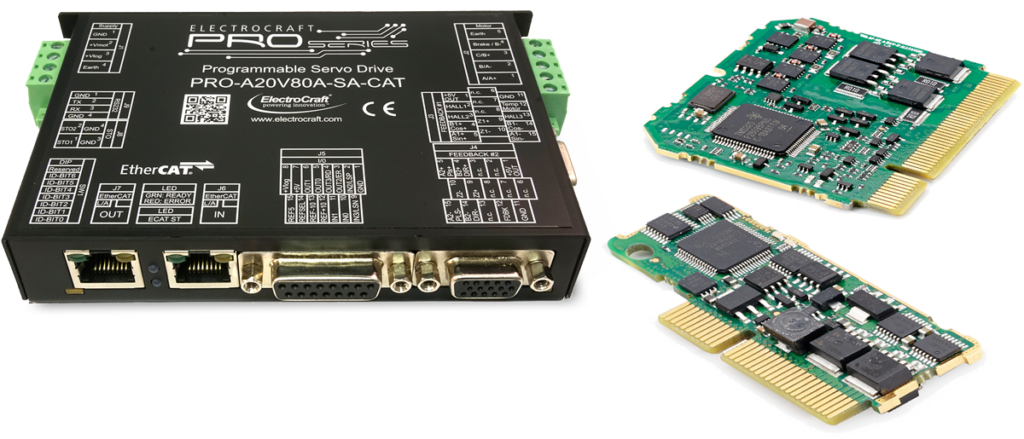
Beyond modifications to the drives themselves,
customization also addresses how servo drives
communicate and integrate with broader control systems.
Servo drives need to integrate into larger, often complex
communication networks and system architectures, with
standard units supporting common industrial protocols
like CANopen® or EtherCAT®. Applications that require
integration with unique, specialized or proprietary
networks outside these standard offerings may demand a
custom solution.
ElectroCraft has extensive experience creating custom
serial-based control protocols (RS-232 and RS-485)
when standard interfaces can’t meet an application’s
requirements. This capability is particularly valuable for
integrating drives with legacy equipment or when a new
accessory must work in harmony with existing systems
using proprietary communication schemes.
Further, in distributed control systems where drives
are located closer to motors, custom features enable
the drives to function as intelligent nodes capable
of electronic gearing or executing motion-trajectory
calculations for tightly coordinated or synchronized
axes. These features are important in many industrial
automation, medical and lab equipment and
semiconductor processing applications, which require
advanced control.
Built-in Protection: The Move From Custom to Standard
ElectroCraft builds comprehensive protection into
standard products as a matter of good engineering
practice. Based on years of customization
experience, these features have moved from “nice
to have” custom requests to standard offerings.
For thermal protection, all standard servo
drives include over-temperature monitoring
with customizable and adjustable temperature
threshold parameters. Drives also support motor
thermistors, with selectable drive parameter
settings to accommodate a variety of thermistor
types. Integrated I²t (current-squared-time)
protection calculates accumulated thermal energy
to prevent motor damage — a standard feature in
quality drives.
Current protection works similarly. Drives
support both peak and continuous current
limits, automatically clamping current and
reducing performance until operation returns
to the continuous range. While users can adjust
these thresholds, the fundamental protection
mechanisms are built into standard products.
ElectroCraft drives also include built-in
electromagnetic brake control — a feature that
many vendors don’t offer but that proves essential
in vertical-axis and safety-critical applications.
Customizing I/O for Enhanced Functionality
Custom I/O is perhaps one of the most frequently
requested customizations. In these use cases, custom
drives often include modified firmware to add functions
to I/O, such as inverting inputs, providing an indicator
status or reporting feedback based on control variables.
In one example, ElectroCraft created a drive that could
be pre-configured to select one of eight configurations
automatically based on I/O pin states. Using a custom
harness that tied specific pins to ground, the drive could
detect and load the appropriate configuration, eliminating
manual setup steps.
Making the Decision
Standard servo drives work well when your application
fits within typical voltage, current and environmental
ratings, requires basic control functionality and uses
common form factors and protocols. Custom drives often
become necessary in applications with space constraints,
harsh environments, demanding power requirements,
ultra-precise motion control, non-standard interfaces or
advanced features like haptics.
For high-volume OEM customers, customization
especially makes sense. Buying larger volumes of drives
justifies the development effort, resulting in optimized
solutions at a lowest cost per unit. You also avoid paying
for unnecessary features while gaining precisely tailored
capabilities.
Because standard products serve as an excellent
jumping-off point for custom solutions, we recommend
starting with standard off-the-shelf options to test
and validate performance requirements. If you find
the standard drive performs well but needs additional
features or modifications, that’s the ideal time to explore
customization. This approach reduces risk by proving the
basic concept before investing in custom development.
To learn more about standard and custom servo
drives, please visit: www.electrocraft.com.